What Are the Top High Performance Routers from China?
China is home to a broad range of networking manufacturers, from established enterprise vendors to specialists in industrial and wireless equipment. Their High-Performance Routers serve different needs: busy offices, data centers, campuses, and demanding home networks. Yet a familiar brand name or impressive box specification does not guarantee strong results.
This guide examines what makes a router worth considering, including real-world throughput, port capacity, Wi-Fi standards, security updates, and management tools. A model with several 10GbE ports may suit a server room, while a compact Wi-Fi 7 device could better serve a modern office. Workload matters. So do heat, firmware quality, support, and the cost of ongoing maintenance. These details can be easy to overlook.
No single ranking fits every buyer. Published speeds depend on test conditions, connected devices, and network configuration, so comparisons deserve careful reading. Some product information may also change between hardware revisions. That deserves a closer look. The following overview will help readers compare Chinese router options by use case and identify questions to ask suppliers before purchasing. It cannot replace independent testing, and even a carefully chosen shortlist may miss a product that performs better in a specific environment.
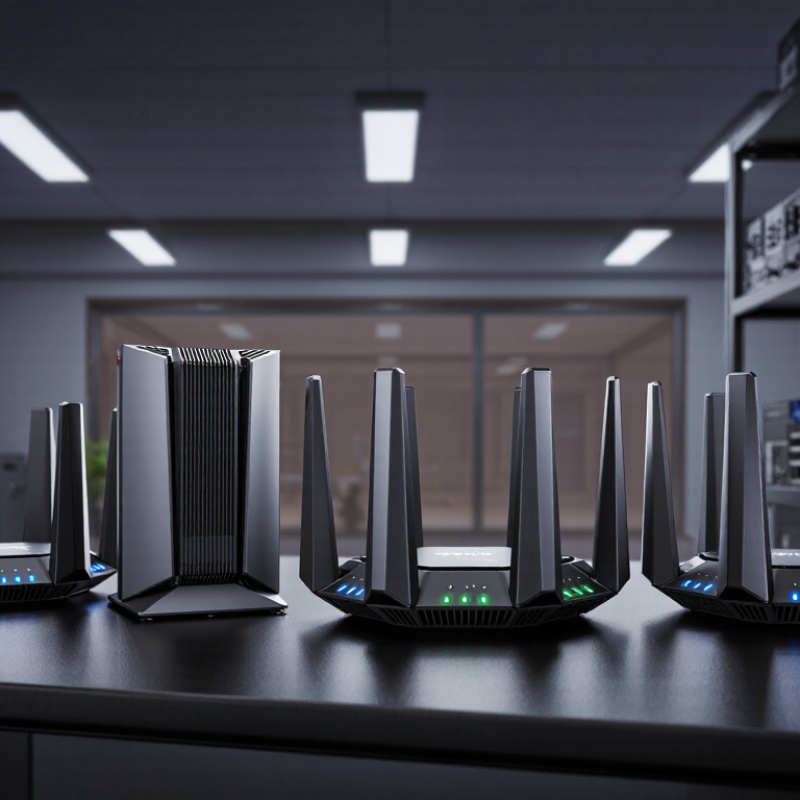
What Defines a High-Performance Router?
A high-performance router is not defined by the peak speed printed on its box. It should move data steadily while several devices stream, work, and make video calls. A useful test is consistent throughput across rooms, not a brief speed burst beside the router. Low latency matters. It keeps calls and games responsive when the network is busy.
Strong hardware helps, but design matters just as much. A capable processor and enough memory can handle many connections without slowing basic tasks. Wi-Fi coverage depends on antenna layout, radio bands, placement, and walls made of brick or concrete. In a home with thick walls, a mesh-ready system may be more practical than one powerful unit. The difference is not always obvious on a specification sheet.
Reliability is less glamorous, yet easy to notice. Look for stable firmware updates, clear security controls, and ports suited to your internet connection. A router should recover cleanly after a power interruption and allow users to manage guest access. When comparing routers made in China, check independent test results, supported standards, and warranty terms. No single lab test predicts performance in every home; room layout and interference can change the outcome.
Which Features Matter When Comparing Chinese Routers?
When comparing high-performance routers from China, start with the space they must cover, not the largest speed number on the box. A two-bedroom apartment with thick concrete walls has different needs from an open office. Check the supported Wi-Fi standard, frequency bands, and whether the router can use wired backhaul with compatible access points. Small details matter. A 2.5-gigabit port can help with fast local transfers, but it will not make a slower internet plan faster.
Look closely at processor capacity, memory, and heat management if several people stream, game, or make video calls at once. During testing, run a speed check near the router, then repeat it behind a closed door and during a busy evening. Compare latency and dropped connections, not just peak throughput. Security updates and clear settings also count. Check how long updates are promised, and whether guest access and device controls are easy to manage. I would be cautious about treating advertised coverage as a guarantee; walls, interference, and placement can change results. Even a capable router may need repositioning.
What Are the Top High Performance Routers from China?
Compare Wi-Fi Generations by Theoretical Maximum Throughput
Wi-Fi 6 and Wi-Fi 6E have the same maximum theoretical throughput; Wi-Fi 6E adds access to the 6 GHz band. Wi-Fi 7 raises the theoretical maximum substantially. When comparing routers, also check supported bands, wired port speeds, coverage, and performance under real-world conditions. Actual speeds are typically lower than these theoretical maxima.
Which Chinese Brands Make High-Performance Routers?
Chinese high-performance routers are made by consumer-networking specialists, telecom-equipment suppliers, and electronics manufacturers with dedicated networking teams. Their strengths vary: some prioritize gaming features and multi-gigabit ports, while others focus on mesh coverage or business-grade management. Compare hardware and software, not just advertised speed. Check for multi-gigabit WAN and LAN ports, regular firmware updates, and clear security-support periods. Test coverage through actual walls, too. A strong signal beside the router proves little in a back bedroom.
The Wi-Fi Alliance’s Wi-Fi CERTIFIED 7 technical material identifies 320 MHz channels and 4K QAM as Wi-Fi 7 capabilities. It states that 4K QAM can raise peak transmission rates by 20% over 1024-QAM under ideal conditions. That is a lab-level advantage, not a whole-home speed promise. Multi-Link Operation can use multiple bands to improve responsiveness, but results depend on client devices and network congestion. When comparing Chinese-made models, review independent tests that record throughput, latency, and temperature over time. One detail is easy to miss: a router may perform well for ten minutes, then slow down as its casing heats up.
What Are the Top High Performance Routers from China? - Which Chinese Brands Make High-Performance Routers?
Figures are standard-level theoretical maxima, not guaranteed real-world speeds or specifications for any particular product. Actual performance depends on the router and client capabilities, channel configuration, distance, interference, wired ports, and regional regulations.
How Do Leading Chinese Router Models Compare?
Chinese high-performance routers are best compared by usable coverage, backhaul, and sustained throughput, not peak box rates. A tri-band Wi-Fi 7 flagship can dedicate a band to mesh backhaul, helping a far bedroom retain speed. A Wi-Fi 6E model may cost less and still suit apartments with gigabit service. Wi-Fi Alliance’s Wi-Fi 7 technical overview specifies 320 MHz channels and 4K QAM; theoretical peak rates reach 46 Gbps. That is the paper ceiling. Walls, client limits, and neighborhood congestion quickly narrow the gap.
For a fair comparison, test each model in the same room and one wall away. Record median download speed, upload speed, and latency across several runs. Ookla’s Speedtest Intelligence reports use real connection measurements, a better guide to everyday results than advertised link rates. Mesh models often improve weak-room coverage, but extra nodes can add cost and setup friction. I would check wired backhaul support and the number of multi-gigabit ports before paying for a flagship. One caveat: a brief test can miss evening congestion. My own comparison would need repeated runs, and even then, placement can skew results.
Which Applications Benefit Most from These Routers?
High-performance routers from China can serve applications where many devices compete for steady connections. Offices benefit from smooth video meetings, cloud access, and large file transfers. On a busy floor, reliable traffic prioritization can keep a call clear while staff upload documents. Campus networks also gain from managing dense Wi-Fi use across classrooms and shared spaces. Latency matters.
Industrial monitoring and retail branches may benefit when routers connect sensors, payment terminals, cameras, and remote management tools. Here, stable performance and clear network segmentation matter more than headline speeds. A router should match the actual number of devices, expected traffic, and available internet service. Even so, the fit is not automatic. A fast router cannot compensate for weak cabling, poor placement, or an overloaded upstream connection.
Tips: Compare real throughput under concurrent load, not only maximum advertised speed. Check support for traffic prioritization, VLANs, VPNs, and WAN failover where needed. Measure coverage at the farthest workstation. One detail is easy to miss: security updates and long-term support affect reliability, too. Test the intended setup before expanding it; a small pilot can expose inconvenient bottlenecks.